How to Identify a Good German Shepherd:What key physical traits should I look for in a good German Shepherd?
Q: What key physical traits should I look for in a good German Shepherd?
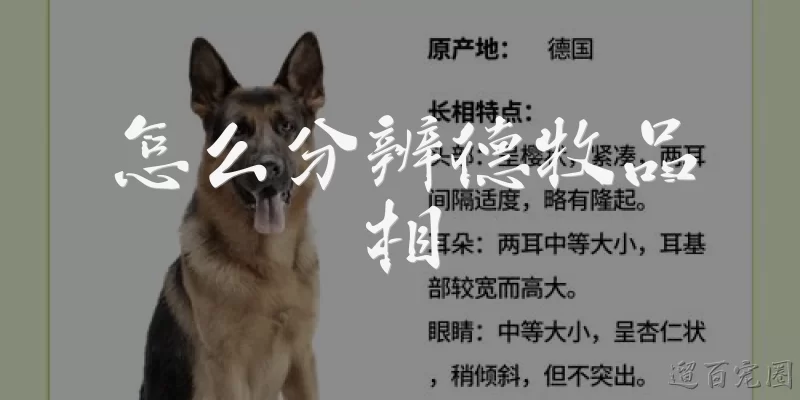
A: According to the American Kennel Club (AKC) breed standard, a good German Shepherd should have a well-proportioned, muscular body with a slightly long, wedge-shaped head and erect ears. The back should be straight and strong, not roached or swaybacked. Males stand 24-26 inches at the withers; females 22-24 inches. The coat can be medium-length or long, with a dense undercoat. The gait should be a smooth, effortless trot. The German Shepherd Dog Club of America (GSDCA) emphasizes overall balance and structural soundness over any single feature, as exaggerations lead to health issues.
Q: How does temperament determine a good German Shepherd according to official breed standards?
A: The AKC breed standard states a good German Shepherd must be confident, alert, and fearless, yet approachable and not hostile. The German Shepherd Dog Club of America (GSDCA) notes the breed should be 'direct and fearless, but not hostile, and must be approachable.' A good GSD is highly intelligent, loyal, and eager to work. Aggression or extreme shyness is a serious fault. The FCI (Fédération Cynologique Internationale) standard also requires self-assurance, a steady nerve, and indifference to strangers when properly introduced. Evaluate temperament through structured tests, not just home observations.
Q: What health certifications indicate a good German Shepherd from a responsible breeder?
A: A good German Shepherd comes from parents with official health clearances. The Orthopedic Foundation for Animals (OFA) recommends hip and elbow evaluations, with results rated excellent, good, fair, or failing. The German Shepherd Dog Club of America (GSDCA) also endorses DNA testing for degenerative myelopathy (DM) and von Willebrand's disease. Breeders should provide OFA or SV (Verein für Deutsche Schäferhunde) certificates. The AKC Canine Health Foundation notes that hip dysplasia and DM are prevalent, so clearances reduce risk. A responsible breeder will also test for thyroid and cardiac issues and provide a written health guarantee.
Q: How can I assess a German Shepherd's working ability and drive as a sign of quality?
A: A good German Shepherd should exhibit strong working drive, according to the German Shepherd Dog Club of America (GSDCA). Look for a dog that is eager to play, retrieve, and problem-solve. The SV (Verein für Deutsche Schäferhunde) breed survey evaluates courage, bonding, and obedience. The AKC Herding Instinct Test and Schutzhund (IPO/IGP) titles demonstrate working ability. A good GSD is not hyperactive but has controlled energy. The FCI standard emphasizes mental stability and trainability. Avoid dogs that are overly aggressive or completely disinterested in interaction. Working ability reflects both genetic heritage and early socialization.
Q: What pedigree and breeder practices distinguish a good German Shepherd from a poor one?
A: The American Kennel Club (AKC) and the German Shepherd Dog Club of America (GSDCA) recommend buying only from breeders who belong to recognized clubs and follow a code of ethics. A good breeder will provide a written contract, allow you to meet the dam and sire, and show proof of health clearances for at least two generations. They will also screen buyers to ensure proper placement. The SV (Verein für Deutsche Schäferhunde) maintains the breed registry in Germany, requiring breed surveys and working titles. Avoid breeders who sell puppies without health testing or who produce multiple litters for profit alone. Reputable breeders prioritize temperament and health over appearance.
Dialogue about
Common scenarios of "How to Identify a Good German Shepherd"
【Sarah (Prospective Buyer)】 Hi Mark, thanks for meeting me. I'm really excited to learn about German Shepherds. I've been thinking about getting one, but I want to make sure I identify a good one.
【Mark (Breeder/Expert)】 Glad to help, Sarah. A good German Shepherd starts with health and temperament. First, ask about health clearances for hips, elbows, and DM. Reputable breeders will have those documents.
【Sarah (Prospective Buyer)】 That makes sense. So, what should I look for in the puppy's parents? Do I need to meet them?
【Mark (Breeder/Expert)】 Absolutely. Meeting the parents gives you insight into temperament and structure. The parents should be friendly but aloof with strangers, confident, and not overly aggressive or shy.
【Sarah (Prospective Buyer)】 I see. And what about the puppy itself? How can I tell if a puppy is well-bred?
【Mark (Breeder/Expert)】 Look for a puppy that is curious, engages with its environment, and recovers quickly from startling noises. Avoid puppies that cower or are overly aggressive. Also, check for clear eyes, clean ears, and a shiny coat.
【Sarah (Prospective Buyer)】 Okay, so temperament testing is important. Should I ask the breeder if they do that?
【Mark (Breeder/Expert)】 Yes, many good breeders perform temperament tests like the Volhard Puppy Aptitude Test. It helps match puppies to appropriate homes. Ask to see the results.
【Sarah (Prospective Buyer)】 Great. What about registration papers? I've heard about AKC and other registries. Does that guarantee a good dog?
【Mark (Breeder/Expert)】 Registration only confirms pedigree, not quality. A good breeder will also show titles on the parents, like IPO, Schutzhund, or conformation. Titles prove the dog can work and has correct structure.
【Sarah (Prospective Buyer)】 So I should look for titled parents. What about the breeder's reputation? How do I check that?
【Mark (Breeder/Expert)】 Ask for references from previous puppy buyers. Also, check breed clubs like the GSDCA. A good breeder will be transparent and welcome questions.
【Sarah (Prospective Buyer)】 I'll do that. Now, about the puppy's environment—what should the breeder's place look like?
【Mark (Breeder/Expert)】 It should be clean, but not sterile. Puppies should be raised indoors with plenty of socialization. They should have access to different surfaces, sounds, and people.
【Sarah (Prospective Buyer)】 That sounds like a lot to check. Is there a checklist I can use?
【Mark (Breeder/Expert)】 Definitely. Start with health clearances, then temperament of parents, then puppy's behavior, then breeder's ethics. Also, ask about vaccination and deworming schedules.
【Sarah (Prospective Buyer)】 And what about the breed lines? I've heard about show lines vs. working lines. Which is better?
【Mark (Breeder/Expert)】 Neither is better; it depends on your lifestyle. Show lines are often calmer, while working lines are higher energy and need a job. Choose based on your activity level.
【Sarah (Prospective Buyer)】 I'm fairly active, so maybe a working line. But I also want a family dog. Can a working line be a good family dog?
【Mark (Breeder/Expert)】 Yes, if you provide enough exercise and mental stimulation. They can be great family dogs if trained and socialized properly. But they need a committed owner.
【Sarah (Prospective Buyer)】 I think I can handle that. One more thing: how do I avoid puppy mills or backyard breeders?
【Mark (Breeder/Expert)】 Red flags: multiple litters on the ground, no health testing, not letting you meet the parents, or selling puppies online without screening. Always visit in person.
【Sarah (Prospective Buyer)】 Thank you, Mark. This has been incredibly helpful. I feel much more prepared to find a good German Shepherd.
【Mark (Breeder/Expert)】 You're welcome, Sarah. Take your time, ask lots of questions, and you'll find the right dog. Good luck!